Archives

The Useful Idiot: The Circle

Absolute freedom and absolute tyranny both can be defined and enforced starting with the individual.  If the individual is not free, neither is society as a whole. If individuals are tyrannical without resistance, society eventually becomes tyrannical. Both the left and right sides of the political spectrum often use the term “useful idiots” to refer to those individuals who are fanatical to a fault in believing in the cause of their respective sides. These individuals are useful in the sense that without them tyranny would not gain a foothold and fools in the sense that they willfully ignore the truth and fail to anticipate the larger picture for the future.

The Circle by Dave Eggers (now a movie starring Emma Watson) tells the story of one useful, unthinking idiot, generally a progressive, but only in the sense that she wants to be part of the “in” crowd. The readers gets the feeling this twenty-something, Mae, would joyfully promote whatever was deemed to be popular and eagerly becomes part of and instigator in what can best be described as a “happy” fascism (see Hitler happy face on Jonah Goldberg’s bestseller Liberal Fascism). Her story instantly brings to mind the timeless quote by C.S. Lewis:

“Of all tyrannies, a tyranny sincerely exercised for the good of its victims may be the most oppressive. It would be better to live under robber barons than under omnipotent moral busybodies. The robber baron’s cruelty may sometimes sleep, his cupidity may at some point be satiated; but those who torment us for our own good will torment us without end for they do so with the approval of their own conscience. They may be more likely to go to Heaven yet at the same time likelier to make a Hell of earth. This very kindness stings with intolerable insult. To be “cured” against one’s will and cured of states which we may not regard as disease is to be put on a level of those who have not yet reached the age of reason or those who never will; to be classed with infants, imbeciles, and domestic animals.”

I read The Circle in about a day and a half. The book consumed me and I think not unlike the unhealthy way that media in general can consume an individual’s attention. It is a horror story in the purest sense, relating our own eagerness to create hell on earth and highlighting that whatever technology humans create, there is always, always a downside. That Egger’s writing reels the reader into being able not to do much but read the story, he is genius in recreating the addictiveness of entertainment and the desire to “know.”

The Circle fits into two story genres for me, the first and perhaps more benign one of young people (often women) obtaining a dream job in which the company consumes their life, draining and using them up all for the almighty dollar. This story belongs alongside The Firm and The Devil Wears Prada as much as it also belongs with 1984. The second category, those stories of totalitarianism is what makes The Circle rise far above the first genre.  In reading the story, those who are well-read or have seen totalitarian films or movies will find instant parallels to 1984, Fahrenheit 451, Brave New World, Minority Report, The Giver, Antitrust, and thousands of other, similar stories.

Mae’s useful idiocy in The Circle is truly amazing. The Circle is a modern tech company with tentacles in every conceivable human endeavor, clearly symbolic of Google, Facebook, Apple, and the like. The story is so horrifying because the consuming nature of social media and modern technology has become evident to all. People spend thousands of hours a year (including myself) scrolling through news feeds, trying out new apps, liking and disliking, and commenting on topics we know little about. We see daily how our privacy is constantly infringed upon, whether it be yet another requirement in airport security or cameras installed (with or without our knowledge) in our neighborhood. This is presumably all to keep us safe, but leaves us more vulnerable than every to tyranny.

Useful idiots are hard to resist because together they make up millions and millions of people.  Technology makes it easy to become disconnected to reality. Just think of all the people rapidly accepting the Transgender movement without question. It’s easy to take on a cause online. One doesn’t have to think or research or actually comprehend the larger picture. With social media, it is also increasingly easy to think that “online” equals reality. Think of when Boko Haram kidnapped hundreds of girls in Africa. What was our response?  The #bringbackourgirls hashtag for Twitter. The Circle parodies this perfectly as Mae “frowns” at a militant group terrorizing another country and then becomes concerned that the militant group will, first of all care that she is virtually frowning at them, and second of all, take steps to stop their behavior. Laughably, she also worries that they will physically try to target and attack her due to her one “frown” among millions of others.

To perhaps highlight just how unthinking Mae is, Eggers shows her as a young woman eager to sleep with almost anyone, even those she’s really not attracted to. This relates directly to the social justice nonsense that people are some how “-ist” (racist, agist, sexist) if they have preferences along race, gender and so on for romantic partners. Just as Mae feels bad if she doesn’t instantly reply to any message from anyone around the world in The Circle system, it’s no jump to figure she would feel just as bad rejecting any of the same people’s sexual advances. One of her partners seems to only use her for sex and then suddenly, inexplicably, relies on her to save the planet from tyranny. Mae isn’t the only useful idiot, just the one we happen to follow in the story.

The part where The Circle implements “instant democracy” is profound. Mae herself still can’t just immediately mark or voice her opinion. She (who has a lot of influence and power by this time) waits until others have given their “smiles” or “frowns” before she herself chooses the most popular option. If there was one thing I could change about modern education it would be to have a class clearly discussing and explaining to young minds just what democracy is and means. Pure democracy isn’t much different from mob rule and the only reason the young champion it is because they are young and are being taught by totalitarians. If all of one’s opinions match perfectly with those already in power, it is easy to think that pure democracy is a great thing. It’s easy to think that the governments have every right to force their citizens to speak or even to think a certain way.

The true horror of The Circle is that it is an all-knowing, all-seeing, mandatory participation system created and run by humans. If atheists think God is awful or should be disbelieved for demanding holiness, they should consider the alternative: humanity trying to be God.  This is the “god” that Satan would have for the world. In this Tower of Babel system, people have no chance to opt out, no rest from interference from their fellow humans, and perhaps most importantly, no forgiveness and no real love.  It is an evil that Boromir of Lord of the Rings would say “does not sleep.”

As harsh, or rather as just as God is, for love of us, He made a way out of punishment and eternal damnation. In Hell, there is no God and no forgiveness. Hell’s inhabitants have no relief from the evil they have done and that is the basis of their torment. We joke that everyone online is permanent, but it’s really no joke, and past information on people (especially of a political nature) is often used as a weapon against them and by all sides.

The invasive tracking of the individual in The Circle also brings to mind biblical prophesies like that in Revelation in which people are forced to wear the “mark of the beast” to buy or sell anything. The ironic thing about constant surveillance and tracking is that it is at the same time very inept. If the NSA tracks our every keystroke, in looking for the criminals, their haystack is impossibly huge. In addition, even though the information is in the “cloud” or “ether,” it still needs a physical space to be stored and itself uses a ton of physical resources. Talk about a burden on nature.

The Circle was so horrifying to me because it’s not so much telling the future, but telling what’s going on right now. The good thing is that people are becoming tired of social media. The bad thing is, once the next big social media site has a foothold, the obsession will start all over again. It’s at once great and also terrifying technology. People are peer-pressured into only sharing positive things online. People are increasingly (myself included) mistaken in the importance of their own opinions and thoughts. People are pushed into holding up only the popular or politically correct views and are more and more afraid of listening to any other views. In fact, young people especially, are starting to believe that any view that doesn’t conform with their own, or that of their college professors, is dangerous, and–even more remarkably–as physically dangerous to their person. This is where the “snowflake” accusation comes into play. We are attempting to make the world into a place where no negative or bad thing is spoken, seen, heard, or felt.  However, as any realist knows, this is futile. It is impossible to erase all of the bad things in the world and it is impossible to make utopia. This experiment is bound to fail in the long run, and worse than failure, will likely end with totalitarian oppression that must be overturned with physical violence. If one side will not listen to the other, if we “don’t use our words” as Stefan Molyneux often says, “we must use our fists.” This is no more clearly shown in episodes like that of the Berkeley riots against anyone on the “right” side of the political spectrum, and the rise of Antifa, purportedly a group against fascism, but fascistic itself and prone to physical violence against anyone who merely disagrees with them. Brave new world indeed.

See Also Murder: book review

As much as I love YA sci-fi and fantasy, adventure, and Regency-era romances, my all-time favorite genre is mystery. Nothing tops a good mystery, and unfortunately they are very rare. My favorite mystery series right now is the Flavia De Luce series by Alan Bradley. I’m reading his latest, Thrice the Brinded Cat Hath Mew’d at a snail’s pace in the hopes I can make it last until the next one is published. I also peruse my local library shelves periodically in the hopes that I will connect with another series. I may have found it.

See Also Murder by Larry D. Sweazy (love the name!) is subtitled “A Marjorie Trumaine Mystery,” so I hope, hope, hope that means there will be more of them. The sleuth is an indexer caught my eye. Once upon a time I worked as a proofreader (oh, how my grammar and spelling have plummeted since then!) and we also had an indexing department in the building. I was always a little jealous because the indexers had their own offices with doors, and aside from having to proofread their spelling and check occasional page references, I didn’t learn much about their job. According to the author of this mystery (a longtime indexer), not just everyone can be one, at least a good one.  Indexing takes a certain kind of mind that can notice key phrases and points in a work and correctly categorize them for future readers. It also might help to be a lister, or one who writes lists. That’s not me. I keep short lists and often either forget I wrote them down in a dusty day planner or typed them into my notes app. Weeks or months later when I open said planner or app in an effort to prove to myself I actually use them, I’m amazed to find these lists and somewhat embarrassed I wrote them down at all.

(Ah, organizing for the sake of organizing. There’s this great line in the movie The Jacket with Adrien Brody: “I’ve been approached by the Federal Trade Organization. … They have asked me to head up the Organization for the Organized!”)

So, one needs a knack for indexing. And Marjorie Trumaine has that knack. She quickly and easily categories and organizes people, ideas, clues and so on. See Also Murder is set in the North Dakota plains in the 1960s and the story is fully infused with the atmosphere and culture of that era. Readers who’ve grown up in middle states, or “flyover country” as it’s often called, will connect with the story in a way the “coasters” probably won’t.

As a mystery, See Also Murder isn’t so much a whodunit (avid mystery buffs will be able to spot the culprit fairly quickly) as it is a character study. Marjorie Trumaine lives a lonely isolated life and it becomes obvious that any threat to her or her husband could quickly become terrifying, especially if they find they can’t trust the few people they know.

I also want to give a shoutout to Scandinavian history and mythology. It’s not something I know a lot about and what I do know mostly comes from the Marvel Thor movies. Sweazy inspired me enough that my latest book purchase was Norse Mythology by Neil Gaiman. I come from half Norwegian, half German stock and once in a while I find it worthwhile to dig into my roots.

See Also Murder is a great, atmospheric read that will stick with readers long after the story has been closed and put away. Isolation is rampant even, and maybe especially, in our modern technology-filled times. Easily seen as both vice and virtue, isolation is a perfect setting for a ghastly murder.  Isolation is the “single effect” (as E.A. Poe would say) that defines the book.

P. Beldona

The Lifeboat: Can You Trust Yourself?

Few stories are more fascinating than those written through the viewpoint of an unreliable narrator.  This is one of the reasons why the book Atonement proved to be so good–that, and the setting.  The Lifeboat by first time author Charlotte Rogan has both elements, as well, the setting being the initial draw for those who like a good sea yarn and are interested in the ocean liner era in which the Titanic sank.  It is also a book that will keep you up all night.

First things first:  The cover art is amazing, showing a lone, half-full lifeboat as a bright spot in the midst of a gloomy blue sea and sky.  The picture is at once beautiful and haunting, immediately capturing the tale in the mind of the reader as one that will be highly affecting, both mentally and emotionally.

thelifeboat

That the main character and narrator of the story, Grace Winter, is unreliable, becomes evident from the first page of the prologue in which Grace, out to lunch with her lawyers, shocks them by standing in a downpour.  She states that they must think her crazy and from how she puts things, Grace herself seems to share their opinion.

Her tale begins similarly to that of the movie Titanic.  Grace is a young, formerly penniless woman who has won the heart of a rich man and they are sailing on the Empress Alexander to New York, where the two are to announce their marriage to his friends and family.  The difference in this story is that Grace loves the rich young man.  The ocean liner sinks, there aren’t enough lifeboats, and those that are filled are not all filled to capacity.  Men, women, and children, drown in the icy waters while the survivors look on helpless to save them, lest they too sink and be drowned.

The biggest part of the novel takes place on the lifeboat where Grace has been saved along with thirty-odd women and a few men.  Grace captivates the reading by tales of treachery, of heroics, self-sacrifice, and spiteful gossip.  Over and over again, she states that what they were all going through makes it nearly impossible to know if some events occurred or not.  Memory is faulty in the best of circumstances.  Add in physical, mental, and spiritual trauma that lasts for weeks and you have a recipe for a break from reality.

Why is Grace Winter now in the company of lawyers?  She and two other women who survived on the lifeboat are on trial for murder.  It is in the final court scenes that we as readers realize how truly unreliable Grace is.  A faulty memory and trauma, we can forgive her for, and we can even forgive her for being manipulated by stronger personalities aboard the boat.  But then, the mask slips a bit, and we see a glimpse or two of the real Grace, the manipulative Grace, and then, just like in Atonement, the entire story is called into question.

Add to that the inexplicable inclusion of some kind of jewel heist to the plot and the book becomes unputdownable.  The hints throughout the story of what is actually going on, are so subtle, that I wasn’t able to peace it altogether.  A smarter reader probably would be able to distinguish by the end just who is manipulating whom (ha, I think I used it correctly there!).

The Lifeboat is a fascinating read precisely because the narrator is unreliable.  The big question we are left with at the end is: just how unreliable is Grace Winter?  The themes of uncertainty of memory, questions others’ intentions, and the tendency of gossip to elaborate upon itself make this a story in which we as readers question ourselves.  Most of us have probably never been stranded aboard a lifeboat at sea, wasting away after days of hunger, dehydration, and lack of sleep, but who of us has not ever questioned our own memory of an incident?  Who of us has not ever had someone else question our memory of an incident?  Police reports abound with witnesses who saw multiple different things at the same time.  Are they lying?  Is their memory faulty?  Or did they all just see different things?

Can you trust yourself?  That’s the question the book presents as we inwardly debate Grace Winter’s reliability.  Are we more or less reliable than her?  If so, why?  We think we know how we might act in such a situation as hers, but we really don’t know until we’re put in that situation.  We wonder if our own character has flaws that will be embarrassingly revealed under pressure.  We desire to be tried and tested, but are afraid we, too, will be found wanting.

The Lifeboat is a book to read in one sitting, if you have the time.  One sitting is the closest way to experience what the characters are experiencing, a situation that they cannot leave or put down to come back to.  One sitting allows the paranoia in the story to grow on a reader so that by the end you are questioning everything, yet have this nagging feeling that that’s just what the author wants, and that you’ve fallen into the trap.  You have been manipulated, but not by Grace.  I look forward to reading further work by Ms. Rogan.  She has talent, and perhaps most importantly, genuine storytelling ability.

Into the Wild: Fairy Tales Run Amok!

Into the WildEver wonder what it would be like to throw all of the old fairy tales together and see what happens?  That’s pretty much the plot of Into the Wild by Sarah Beth Durnst.  The “Wild” is a storybook forest that’s goal is to complete story upon story of fairy tales, recycling the characters such as Rapunzel and Cinderella through their stories over and over again with no end.  Rapulzel or Zel, as she’s called in the story has beaten the Wild once before, forcing the forest into a little tumble of weeds that hides under her daughter’s bed.  All of the fairy tale characters have moved into the real world and set up homes, businesses, etc, and are all too happy to be away from their respective stories.

Julie, the daughter, has grown up knowing the characters apart from their tales and thinks of the Wild as a nuisance that eats her shoes and turns them into Seven League Boots.  She knows her grandmother, not as the witch she once was in the Wild, but as someone caring and loving, who has a good relationship with Zel and would never want her back in the tower.  Julie’s father is MIA, and no one seems to want to tell her what happened to him.

The Wild, being, well, wild, gets out of control, taking over Julie’s town and imprisoning her mother and friends back in their stories and taking townsfolk with them.  Anyone stuck in the growing forest could become a knock off Red Riding Hood or Sleeping Beauty.  Julie finds she must navigate the strange rules of the Wild in order to save her mother, grandmother, the town, the world…you get the idea.

I loved this book!  It’s a quick read and is for younger readers, so romance is thankfully thin, and the adventure thick, magical, and leafy.  References abound for those who know their Brothers Grimm, Hans Christian Anderson, and the like, and the stories generally stick to their original alarming endings.

If you need a change from YA fairy tale romances, give this a try.

I also attempted to read Winterspell, a YA romance loosely based on The Nutcracker and sadly, I could not finish it.  Slinking seductively in the arms of a statue just…should not happen, I don’t care if the statue does turn out to be an enchanted prince.  The sexual awakening and predator scenes dragged the beginning of the book, and having the prince run around naked for an extended time after that just became creepy.  Guys aren’t just pieces of meat either, you know!  A lesson I dearly hope Clara learns throughout the story, though I did not want to take the time to find out.  I like to think of YA fantasy-romances as something apart from the “Romance” genre, but maybe I’m kidding myself.  At any rate, kudos to the author for trying to tell The Nutcracker in a new way.  Sadly, it just wasn’t for me.

Why Do Dramas Do That? – ebook review

Why Do Dramas Do That?Why Do Dramas Do That?: Part One is the first in an informative ebook series about Korean TV dramas, or Kdramas.  This is a must-read for any Kdrama fan, especially one not from South Korean culture.  The ebook has a lot going for it:  It is short, to the point, and separated into easily-navigated chapters detailing key South Korean culture points, lingo, characters, story arcs and the like.  This information makes watching Korean TV all the more exciting.  For instance, I had no idea just how crazy the shooting schedules of Korean TV can be, so I enjoyed the tidbits and stories regarding that the most.

The ebook is written by JavaBeans and GirlFriday, the creators of a great website called dramabeans.com.  If you want awesome Kdrama reviews, check out their site.  You won’t be disappointed, as the reviews are in depth and insightful, and it’s obvious that the writers truly appreciate the subject matter.  They also have a wealth of viewing history and thus information, so they are truly informed critics.  I, for one, cannot wait for the next part in the series.

2015 Reading List


books

If you’re a bookworm like myself, you like always have a stack of books waiting to be read in your spare time. Here are a few that I can’t wait to crack open and get into the adventures already!

1. Mary Barton by Elizabeth Gaskell.  Ever since watching the BBC miniseries of North and South and Wives and Daughters, both by Ms. Gaskell, I’m hooked on her stories.  Mary Barton promises to be the most exciting of the three, as the plot boasts both a murder mystery and jail time for the leading lady.  My copy is an old paperback of my Dad’s.  He remembers the story fondly and as being pleasantly exciting, as he had to read it for school.

2. The Four Graces by D.E. Stevenson.  In 2014 I read the first of Stevenson’s books, and I think I’m in love.  She’s a comedic, yet poignant author, with relatable heroines and provincial life tales that share quaint similarities to the works of L.M Montgomery (Anne of Green Gables).

3 & 4.  The Girl Who Could Fly by Victoria Forester and Into the Wild by Sarah Beth Durst.  No year can go by without me getting my YA/juvie fantasy fix, and I have a great friend who sent me these books for the holidays, and finally, finally, I will have time to read them!

5. The Crochet Stitch Bible by Betty Barnden.  Everything I’ve every wanted to know about crocheting.  I have discovered, that no, I am not a knitter, but a crocheter, and with a long Minnesota winter settling in, I hope to crochet a few scarves and/or blankets while I get my K-drama fix.  Reading, watching, crocheting all at once.  I think I’m addicted to multitasking.

6. In the Kingdom of Ice by Hampton Sides.  I’m a shameless fan of great historical yarns, and this promises to be one, being about “the grand and terrible polar voyage of the USS Jeannette.”  I also want to get to In the Heart of the Sea by Nathaniel Philbrick, but that won’t be until much later in the year, and I kinda want to see the movie first.

7. Poems: Rossetti by Christina Rossetti.  This is a book I bought in college.  I’ve read most of the poems, but not all, and this year would like to read it cover to cover.  Christina Rossetti is one of my favorite poets, as she combines faith and imagination in wonderful ways.

8. Winterspell by Claire Legrand. The latest book I happened to come across during my weekly wander through my local B&N. This is what sounds like a fantastic retelling of The Nutcracker, and a good after-Christmas tale to get me through the doldrums of winter.  Plus, I’m familiar enough with ballet to enjoy the references, but not such a big fan that I will shudder at every change.  I’m hoping this one’s a keeper.

9. Trolls for Dust: Season One by moi.  Shameless plugging, I know, but what writer’s blog would be complete without it?  They don’t tell you when you become a writer that you better like your own stories, because you’ll have to read and reread and reread them, especially if you’re writing a series and want to make it all cohesive and stuff.  TfD Season Two is still on its way, and I’m so glad to have writing time again.

Cheers to 2015, and as always, Happy Reading!  –Pixie

Thanksgiving Thoughts

Happy almost Thanksgiving!  The day on which we hopefully realize how much we do actually have in our lives and to whom we owe them.  For me, it’s God, always and forever, and I’m amazed he gets me out of the messes I make — and I make a lot.

Syfy’s Haven: So, so good!  Give it a try on Netflix if you haven’t checked it out yet.  I will be back next week with more thoughts on Season 5.

Book recommend: Station Eleven by Emily St. John Mandel is a wonderful read full of thoughtful moments and a new angle on the pandemic-ending-civilization storyline.  I’m enjoying it so much, I don’t want to finish it because then it would be over.

The Five Fingers: Ok, I said I was going to review this K-drama, but getting to episode five ending up being torture — too much soap opera and not enough interesting and/or funny drama.  Plus, I couldn’t take anymore kid crying.  It started to make my ears ring.  I love that it’s about piano prodigy brothers, and maybe I’ll give it a shot again sometime, but this just wasn’t for me.

CW’s Reign: Wow. Love it. Addicting guilty pleasure starring Adelaide Kane and the awesome Megan Follows (Anne of Green Gables).  It loosely (and I stress loosely) follows the story of Mary Queen of Scots.  The costumes are Renaissance Fair cool and the music is contemporary.  The content is rather adult, especially for younger viewers, but it’s a compelling story of a girl learning how to rule as a queen, with all of the responsibilities and heartbreaking choices it entails.

Until next week,

Pixie

Jane Austen fan fiction: Death Comes to Pemberley and Longbourn

Death Comes to PemberleyLately, I’ve been on a Jane Austen fan fiction kick.  Austenland was an entertaining movie and great book, so I decided to check out the BBC version of P.D. James’s Death Comes to Pemberly.

Death Comes to Pemberley has good and bad about it.  The good:  Matthew Goode is the perfect Wickham and I wish we could go back in time a few years and have him play Wickham in the Keira Knightley version.  I also enjoyed Lydia and Mr. and Mrs. Bennett.  All four of these characters seemed more or less as if they’d walked off of the pages of P&P.  Also good, the mystery itself proved layered and intriguing, and the characters, like Sir Hardcastle (Trevor Eve, who looks eerily like Ben Franklin in this role), lawyer Henry Galveston (James Norton of Happy Valley), and Louisa Bidwell (Nichola Burley) were great additions to the P&P world.  Mr. Darcy, played by Matthew Rhys seemed more or less himself, except perhaps a bit too severe in manner considering he’s been married to the love of his life for a few years now.

The bad: Elizabeth Darcy.  Anna Maxwell Martin (Becoming Jane, North & South, The Bletchley Circle) is a stellar actress, and perfect for most period films and shows.  As Elizabeth Darcy née Bennett, however, she is outright miscast, not only in looks, but also in manner.  Everyone pictures characters differently in their heads, but I never once thought of any of the Bennetts as being especially skinny.  They like good food, parties, balls, and sit for hours on end reading, sewing, etc.  A plump or healthy looking Elizabeth with rosy cheeks, and a face that draws the attention from everyone else in the room would make more sense.  Mr. Bennett married his silly wife because she had great looks, and everything in P&P insinuates that all of the girls, especially Jane, Elizabeth, and Lydia (and perhaps excepting Mary) inherited those same good looks.  Martin is good looking in her own right, but is by no means an Elizabeth Bennet/Darcy.  One cannot imagine her catching Darcy’s eye at all.

Besides that, her Elizabeth looks tired all the time and as if she has lost her enjoyment in life, has almost no wit to speak of, and no sense of style when it comes to dress.  This was such a glaring casting (and costuming) error, I have to wonder what the casting director and producers were thinking.  A better choice, though maybe not as well known, would have been Daniela Denbe-Ashe of the wonderful North & South (book by Elizabeth Gaskell), as suggested by an imdb.com user (I love reading the message boards on that site).  She has the right looks and also the right manner of someone who is unused to hardship, going by her great performance as Margaret Hale in North & South, which holds many similarities to Pride and Prejudice.

Being fan fiction, the Death Comes to Pemberley as a whole is not “Austen.”  Not that murder should ever be taken lightly, but it is possible to tell a light-hearted murder mystery, which would have suited this flattery to the classical author much better.  The whole love of Austen’s books has not much to do with how realistically she described the dirtiness or suffering of the times in which she lived, but her comic wit and spot on characters who are situated specifically in an upper class sort of life that doesn’t dive down into the mud.  Austen specifically chose to write this way, and refers to harsher realities only obliquely.  Making the stories “real” and in general depressing, is the key mistake that most Austen fan fiction writers make.  Jane Austen’s stories, although holding many truths, are light-hearted, generally follow and poke fun at Regency life, and are marked first and foremost by her amazing wit, and beyond that, her brevity.  The characters are never in any real danger, except of being lost to “good” society.  The miniseries was an improvement upon the actual Death Comes to Pemberly book by P.D. James, whose long-windedness and misunderstanding of Austen’s appeal made it impossible for me to get through even a chapter.

LongbournLongbourn by Jo Baker.  Much of the same criticisms I have for P.D. James hold true for this work as well.  The novel started out promising, P&P told from the viewpoint of the servants, but all too quickly the long descriptions begin to wear, as do the unnecessary knife digs at the family whom the servants serve.  In our modern eyes, servanthood appears to be a great evil, and this is continually the thrust of Baker’s tale. Her assumption is that the servants are unhappy with their work and station in life.  Cataloguing the woes and difficulties of being a Regency era servant could be an interesting tale, it’s just something that doesn’t jive with the original P&P story, and has more the effect of a long diatribe trying to make modern readers feel guilty for past so-called sins of their ancestors.

Longbourn revels in dirt, mud, chamber pots, and pages of description that bog the story down and you only remember it’s the story of P&P when Baker remembers to mention the girls’ soiled menstrual cloths.  Where is the delight that Jane Austen took in the world despite the troubles in it?  Where is her wit, her brevity, her wonderfully drawn characters who are happily and comically flawed?  It is as if Baker were plagued with Dorothea Brooke-itis from Middlemarch (by George Eliot), wherein she considers suffering of the lower classes to be the only virtue and the only thing worth remedying, and that enjoying life (like the Bennetts generally do) is somehow a sin, as is poking fun at ridiculous characters, like Mr. Collins, when they are behaving both ridiculously and rudely.

In this sense, Longbourn is no compliment to Austen, but a backhanded slap.  So what if Austen didn’t regale us on the suffering (debatable) servant class or other classes?  It doesn’t follow that she had no sympathy for their various plights, or that her own class was free of worry or trouble in the world.  Everyone suffers in this world, no matter their station.  The character of a person, their outlook on life, their faith, their hope, what they love, all contribute to their happiness in the world.  Some people are never happy no matter their station, and some are ecstatic in whatever sphere they find themselves. We don’t have to, like Dorothea Brooke, feel guilty about enjoying where we are in life, even if we are middle or upper class.  We don’t have to, like Hermione Granger of Harry Potter, interfere on behalf of lower classes that may actually not want our help, classes that may actually enjoy their station in life and resent our good intentions.  This is the “people’s history” of Pride and Prejudice, in which we are scolded for enjoying any frivolous pursuits, especially novels of humor, wit, and a love story where the main characters end up happy and (shock) do not consider daily their dear, saintly suffering servants.

I gave up on this book about halfway through.  Had it been a book apart from P&P, I think I still wouldn’t have finished it, mostly due to the too-long descriptions.  There is a saying that “brevity is the soul of wit,” and this is so true when considering Austen’s works.  Emma is the longest novel, but they all are rather short compared with modern doorstop tomes.  Describing things in detail for pages on end isn’t necessarily good writing, and most certainly not good storytelling.  I, too, am plagued with purple prose from time to time and it is a difficult vice to shake.  One thing I will say for Baker: what a great idea for a fan fic, and refreshing compared to other works that feature the main P&P characters, but botch them abominably.  Her attitude towards the Bennetts in this book is a bit mean spirited, but she managed to portray them more or less accurately.

On another note, I am super excited for the BBC presentation of Pride & Prejudice and Zombies!  It’s fan fiction as well, but the book kept up a spirit of lightheartedness and fun throughout, despite the rotting flesh descriptions and wounds that made me too ill to my stomach to continue beyond Elizabeth’s ninja attack on Mr. Darcy.  Visually, my stomach isn’t quite so queasy and I think this flattery to Austen might be the most complimentary yet.

How Is a Raven Like a Writing Desk?: A book review of Gabriel Finley and the Raven’s Riddle

Gabriel FinleyAwhile ago I wrote three posts entitled “The Next Harry Potter” with suggestions of possible book series  that could fit the bill, so to squawk – I mean speak.  For volunteering at the Minneapolis Book Festival this past October, I received a number of free books, many signed by the author.  One of those was Gabriel Finley & the Raven’s Riddle, the first book in (I hope) a series, that like Harry Potter has the titular figure trying to make his way in a new and strange magical world.

Gabriel Finley is an orphaned boy much like other boys in children’s stories.  He lives with an eccentric aunt and doesn’t really know what happened to his parents.  That all changes when one day he discovers he can talk to ravens, and that he and ravens share a common love of riddles.  The book takes readers to a magical world involving ravens, riddles, puns, and a powerful, elusive necklace called a torc.  It may be a bit gruesome in parts for younger readers, but on the whole is a fun story in which kids learn to work together to solve the case and to understand one another.  It’s also a great Halloween tale with several riddles for readers to solve throughout the book.  It reminds me a little of Harry Potter, The Mysterious Benedict SocietyThe Lord of the Rings, and Narnia.  It also has a few odes to Alice in Wonderland.  My favorite element in the tale was a raven-clawed writing desk that likes to dance and disguise itself in people clothes.

The story is unique in its affection for word puzzles as well as birds.  I do hope there will be a sequel of some kind, as there are many hints that birds aren’t the only magical creatures around in this world.  It’s authored by George Hagen and you can find more information about the story at gabrielfinley.com.

How Is a Raven Like a Writing Desk?  I’ll let you be the judge of that after you’ve read the book.  🙂


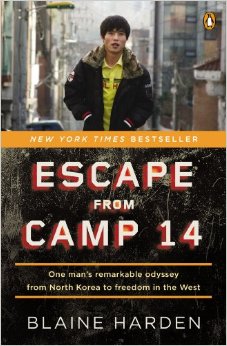
Book Review: Escape from Camp 14

Escape from Camp 14Escape from Camp 14 is one of those true stories that makes one question oneself.  Shin Dong-Hyuk, the titled escapee, is from the beginning presented as an unreliable narrator.  The author, Blaine Harden, is a journalist attempting to set the record straight on what actually happened in Shin’s life, as Shin has changed his story from the first time Harden wrote about him.

If we’re used to reading fiction, we as readers don’t often fully considered unreliable narrators.  If we’re citizens of affluent countries reading about hardships in other countries our expectations tend to be a desire for some kind of cathartic experience.  This is reflected in many of the reviews of the book both on Amazon and Goodreads where readers express their frustration that they did not have an emotional connection with the main character.  This is said to be Harden and also Shin’s fault, but I pose the possibility that this has nothing to do with them, but our expectations as readers.  Why do we desire a cathartic experience from Shin’s story?  Does he owe us this for some reason?  Will we have our experience and then go on and take down the North Korean government?  Will we throw money at the problem and hope it goes away?  These questions are not to blame readers, but to probe our expectations.  Yes, Shin is an unreliable narrator.  He’s human and just as sinful as both us and his oppressors.  Sometimes we forget that like any human being, victims sometimes lie, are sometimes selfish, and often don’t fit into whatever box in our mind that we’ve created for them.

Shin is a victim because he was raised in the camps, but he’s also not a victim, he’s a survivor.  He feels guilt for what he did in the camps, but all of his betrayals, right or not, helped him to survive.  He’s still trying to survive in a world where he’s expected to behave like someone who grew up in freedom.  He’s expected to be honest, but was never raised to be honest.  Yes, his lying is irritating, but does it really lessen his story?  It’s obvious he went through trauma of some kind, and I think it’s kind of morbid on our part to want the victim to recount their awful experiences in gory detail just so we can have an emotional connection.  These people are plagued by guilt and continual nightmares and we want catharsis for ourselves, just because we want to be entertained.  I ask again, does an emotional response mean we are actually going to do something about the problem, or will we think on it a day or two and move on with our lives?  This isn’t, again, to criticize, this is to be realistic.  Stories of this kind are important to be told, but for most it’s one book in a long line of books that we read in our lifetime.  So our expectations should perhaps be more reasonable.  The truth isn’t easy to come by.  It wasn’t during WWII with the Nazi camps, and it isn’t now.  Shin’s story is his story and if we learn something from it (even if the details aren’t exactly perfect), that’s not a bad thing, and in the end, he doesn’t owe us a thing.  We can criticize his way of thinking and his actions, but that’s not going to change his actions or his way of thinking.  He’s a flawed human being, just like we are.  And just like us, he knows his faults and is trying to remedy them.

Speaking of criticism, I found the paragraphs discussing the callousness of South Korea’s response to the atrocities of the North as the pot calling the kettle black.  South Korea and the United States are both driven by work, success, and the like.  We like working, want to succeed, and have done so many times over, often to the peril of personal relationships and human kindness.  This, however, does not make Capitalism, competition, making money, or the drive to succeed bad in and of themselves.  To try to succeed in life is honorable, to make something of ourselves is also honorable.  To step on others to get there, not so much, but this is something we have in common with Shin.  It’s not always an easy choice.  Our advantages often come on the backs of other’s disadvantages.  If our ally got to the barbed wire first, suffered and died because of it, is it right for us to climb over his dead body to escape?  If we survive, we feel guilty; if we succeed we also feel guilty.  We are so lost to the truth, that we can’t even be sure if our guilt is justified.  We feel guilty about feeling guilty.  Is forgiveness even possible?

As a Christian, I believe it is through our Savior Jesus, who died that we might live, who took all that pain, guilt, and pseudo guilt on himself, so we could wear robes of holiness in the eyes of God, and be saved.  It’s easy to criticize people, societies, and countries for doing nothing about atrocities, but what honestly could we do that’s ever enough?  Could tons of money solve the problem of North Korea?  Could an invasion or a takeover?  We could maybe end the camps, but can we stop the thinking that leads to the camps?  WWII ended Hitler, but it didn’t end the thinking and ideas that made his takeover possible in the first place.

These questions also pale in comparison to a more immediate problem: Claiming to care these days is considered to be moral high ground.  The southern border problems of the U.S. are case in point.  So many people claimed to care about the thousands of children coming across our border this year, but their caring (including mine) stopped at actually addressing not only the problem, but also the concerns of citizens in allowing so many to cross our border at one time and stay indefinitely.  The people with concerns got criticized harshly while those who “cared” got to act holier than thou by proclaiming how much they cared on social media.  And now that crisis has been overtaken by the latest fear of Ebola in which the same puppetry plays out.  This claiming to care, this need for catharsis from others’ sufferings, are just that old selfish human nature coming to raise his ugly head.  If we claim to care, we can feel good about ourselves, even if we will not or cannot do anything about the problem.  Same with an emotional response.  If we have the right emotional response to an atrocity, well, we must be good people even if our very next act is to go about our daily lives as if that catharsis never happened.  We snottily tell others what they should pay for, all without ever planning to give a penny of our own income.  The petty tyranny of “good intentions” is alive and well today as it always has been.

Petty tyrannies are only part of the real threat to freedom: actual Tyranny.  Put the blame where it belongs, on the North Korean officials who perpetuate this awful system of oppression and fear.  Is “the system” really an excuse for the evil men do?  Did all of the people have go along with the Nazis and their concentration camps?  They could have rebelled (some did) at the cost to their own lives.  It’s never an easy choice to do the right thing, and sometimes we aren’t even sure what the right thing is, but putting the blame on those who live in freedom is faulty at best.  The free people are criticized severely no matter which choice they make, to help or not.  Our cry of compassion should not be for others to give what they have, but for us to give what we have, for us to be the change we want to see in the world.  Even Shin, who was not taught honesty, knows this.  It’s why he struggles with nightmares and guilt, and is frustrated by those well-intentioned people who think they know exactly what he should do with his life.  It is so very easy to spend other’s time and money, to tell others what they should care about, who they should help, and to dismiss their fears.  How much harder it is for we as individuals to put our own time, money, and effort on the line!  To put our own skin in the game and struggle with the problems that can come with (fore example) a mass migration no matter the reason.  Skin in the game is why, despite its flaws Capitalism and competition are superior to both Socialism and Communism.

Even today, too many young people are still taught that Socialism and Communism are good things.  They are taught that the evilness of human nature only comes out in Capitalism, consumerism and competition.  They are taught to look at those who own businesses and make money as evil.  The young are taught this in free societies thriving on competition and Capitalism, in places where they themselves have little to no threat of the tyranny and death toll that both Socialism and Communism bring.  They are taught that those who invest should reap the same reward as the employee who is flipping hamburgers, despite the fact that the investors may have put days or years of more time into their work efforts, and also a lot more money.  Are burger flippers really in the same situation as Shin in Camp 14?  Do they honestly have no other choice but to be burger flippers?  If they “escape” the burger flipping by working harder, taking the risk to move up in management, or paying for more education, should they be chastised?  Are they climbing over their colleagues’ dead bodies to get through the electric, barbed fence?  Greed is a sin, yes, but envy is too, and “Workers of the World Unite!” is the cry of both the greedy and the envious without at least the virtue of hard work to temper it.  It is a cry that falls prey, time and again, to the tyrants of this world – and there are many.  Self-sufficiency (as apart from government) is the best way of keeping tyrants at bay.  Human nature is selfish, and those that promise a new system where everyone is “equal” or forced into equal outcomes in life, is only a cover for those tyrants who wish to have more of the proverbial pie than most.

Socialism and Communism are most often idealized by the young, because they are childish notions with little understanding of how the world and selfish human nature work.  Capitalism and Republics, for all of their faults, are for adults, those who wish to make their own paths in life and who are willing to risk failure in order to succeed.  It’s hard to force people into freedom and self-sufficiency, because they are alien ways of thought in much of modern life.  We are inundated daily with the idea that governments hold the key to all happiness for society.  But how can this be when governments are run by flawed people who are at heart selfish, and who only want to stay elected, and keep their jobs, so they don’t have to invest in another career?  Time and again, we are shown just how greedy so many officials and politicians can be with money that they did not earn and that is in no way their own, and yet we still believe the Communism/Socialism/Nazism/Totalitarian fairy tale.  True, having too much can corrupt, but so can having too little.  Envy is a different beast than greed, hiding in the deep recesses of our hearts, it gnaws away at us, a green monster to which an honest and open greed pales in comparison.  Shin is actually pretty honest in what he wants: a full belly.  He wants to eat, and eat well, and he is doing what he can to ensure that happens.  And he is also at least striving to tell his story and in some small way help those who are still prisoners of the country we call North Korea.  May God be with him in his continued struggles and help to find peace of mind and the forgiveness that all of us need so desperately.  And may God help us to put our expectations where they belong, on ourselves first and foremost, to be His hands, and His good in this world.