In Search of a Good Mystery

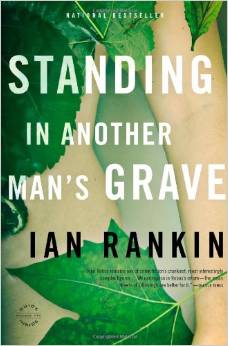
UnknownIf you’re a reader, like me you may keep either a written or mental list of writers, series, or books that you’d someday like to try.  Longtime mystery author Ian Rankin has been on my list for about a year or two, now.  In fact, last year, I tried one of his stories not connected to his Inspector Rebus series and for whatever reason didn’t connect with it.  Rankin’s 18th novel in his Rebus series was available at my local library, and, as the mystery itself sounded intriguing, I decided to give him another shot even though I know almost nothing about the series.
Almost to my surprise, I enjoyed Standing in Another Man’s Grave.  Rankin slips information necessary from previous books in with newer material, and as a result, I felt like I was reading the beginning of a new Rebus series.  There’s something particularly comfortable about older codgerier (okay that’s not a word) detectives.  They have at their stage in life little desire to make themselves look good–their interest is the work.  Rebus is pretty typical of fictional detectives these days.  He’s unorthodox, doesn’t follow the rules, has several vices, and is smarter than almost everyone else in the book.  Rebus is so typical I thought I would be bored by him, exasperated even, but I was not.  Maybe it was the setting.  Having been to Scotland, including Edinburgh and Inverness, I could picture a lot of the places and roadways, and that’s always a bit exciting as a reader.  Maybe it was the fact it was a cold case.  Cold cases can often be more intriguing simply because the mystery of whodunnit has lingered for so many years.  (Incidentally, this is exactly why Zodiac is one of my favorite movies).  Maybe it was just the fact that Rebus is older.  Old detectives are pretty awesome, from Hercule Poirot to the Peculiar Crimes duo of Bryant and May.  And, let’s not forget Miss Marple.

This post is a shoutout to Mr. Rankin for having a storyline and hero engaging enough that even in his eighteenth installment, Rebus delivers and makes me want to read the series from the beginning.

Since so many readers are always in search of a good mystery, I offer a few series that I have enjoyed over the years in addition to this one:

Agatha Christie’s Miss Marple and Hercule Poirot books.  (Short, comfortable reads often full of unexpected adventures)

Christopher Fowler’s Peculiar Crimes series starring John May and Arthur Bryant (A must for history buffs, especially)

Frank Tallis’ Vienna murder mystery series. (For those who like history and psychology.  The descriptions of food and music add a unique aspect as do many of the plots that revolve or hint at the future atrocities of the Third Reich)

Dorothy L. Sayers’ Lord Peter Wimsey mysteries.  (Gaudy Night is the best one, but the series as a whole is outstanding and a good exploration of a upper class detective and his not so easily won lady love, Harriet Vane).

Anna Dean’s Dido Kent mysteries. (Mysteries set in Jane Austen’s world that kindly don’t involve Miss Austen whatsoever).

Elizabeth George’s Inspector Lynley series. (Set in the UK, as with most of these, and also involving an upper class detective.  I enjoy the mysteries, but not so much Lynley’s complicated love life.  His partner, Barbara, is awesome.  She rankles against his poshness to great effect.)

City Hunter review

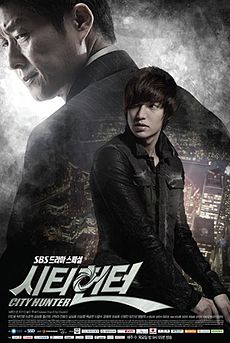
City-hunterEpisode one of City Hunter,  the Korean TV drama based on a Japanese manga, is one of the most intriguing and exciting setups I’ve ever seen for a show.  It sets the stage for political drama, a Monte Cristo-styled revenge, heroes who are loveably flawed, and a sweet romance.  The basic plot of the show is this: After a botched mission into North Korea, an army general named Lee Jin Pyo (Kim Sang-Joong) is out for revenge and kidnaps his best friend’s baby to be his instrument.  Jin Pyo is a patient man, he builds an empire and raises the boy, Lee Yoon-Sung (Lee Min-Ho), as his own for twenty-seven years, teaching him to be a ruthless killer.  Despite his upbringing, Yoon-Sung is a good person and heart and loves his adopted father.  He moves to Seoul, South Korea, and begins to execute Jin Pyo’s plan, taking five corrupt government officials down one by one in style.

The action in City Hunter is outstanding, many of the moves unexpected, and this is where both Lee Min-Ho and his character really carry the show.  Kim Sang-Joong is no slouch either as “the General”  and throughout the show is the perfect antagonist to Lee’s protagonist.  As much as the show is about bringing dishonest politicians (but I repeat myself) to justice, the heart of the story is the relationship between adopted father and son.

City Hunter has several supporting characters, one of them being an eager government prosecutor played by Lee Joon-Hyuk, who goes from being an enemy of Yoon-Sung to a collaborator in his plan to reveal the crimes to the public.  Joon-Hyuk gives an outstanding performance as does Hwang Sun-Hee who plays his character’s love interest, a gentle veterinarian.  City Hunter is a bit of a Robin Hood character and Bae Man-Duk (Kim Sang-Ho) is the perfect Little John.  He’s a sweet-hearted gambler with a motherly side and a dangerous addiction to the Home Shopping channel.  Bae is my favorite character in the series and I don’t think he’s used enough.

As with any superhero or masked man, City Hunter is not allowed to fall in love for fear that it would compromise him.  Of course he begins falling in love years before his plan will even be executed.  Kim Na-Na is a good foil for Lee Yoon-Sung.  She never quite buys his cover story maybe because she herself has had a tough life and has had to take care of herself, sometimes lying to do so.  Park Min-Young as Kim Na-Na won me over by the end of the show, but many times I thought she appeared too young and childish next to Lee Min-Ho, who, although also young carries many of his scenes in a much more mature fashion.  Kim Na-Na is also the worst body guard on the planet and it strains credulity that she would have even been considered to work at the Blue House, she’s that inept.  Perhaps it was a writing problem.  In any case, Park Min-Young did the best she could, and again, did win me over by the end.

Aside from the politicians under siege, most of the minor characters could really have been done without, including the hero’s mother, who is kept around mainly to reveal a twist at the end.  The twist wasn’t really necessary from the hero’s perspective––Lee Yoon-Sung would have been conflicted either way––but it does reveal just how single-minded and tortured the General Jin Pyo is.

The show uses the fact that Jin Pyo made zillions of dollars being a drug dealer in the Golden Triangle to full advantage, from elaborate house locations, to the sometimes silly fashions that Yoon-Sung sports.  The high-class lifestyle enhances the rather fluffy romantic comedy humor running throughout, the best of that being the scenes where the female body guards teach judo to the IT members of the Blue House (S. Korea’s White House) security team.  (Yoon-Sung’s cover is that of an MIT grad from America who has returned to his home country to settle down.)

All in all, City Hunter is a great watch, but slow in parts and could have done with more action, as that is definitely its strength.  The ending is fantastic, with standout performances all around, and the resolution is left fittingly vague.  The storyline raises questions about bringing officials to justice and whether their faults are totally their own or more of a symptom of a government system in which no one’s hands are clean.  All of the characters, whether working in government or not are all wonderfully, humanly flawed.  The hero, although mostly pure of heart, is a drug dealer’s son.  He dreams of living a normal life, not of saving the world.  For the General, his revenge justifies all the means he uses to meet it out.  The big question is this:  Is the revenge worse than the initial crime?  It’s never really answered and left open to the viewer.  The City Hunter does both good and harm by the end of the series.

On a side note, as an American, I found it amusing that privatizing health care was posed as being such a bad thing when they clearly showed over and over again just how corrupt government was.  In my experience, the more involvement government has in something, the more it costs all around.  People often think of any government money as “free” and take liberties with that money that would never take if a private enterprise was running the show.  This cavalier attitude is what drives prices up and up.  College tuition is a prime example.  Without the large cushion of government loans, colleges and universities would be forced to set tuition at a more competitive price or risk going out of business.  That’s my opinion, anyway.  The main point of City Hunter for me was that government needs to be held to account in every area it runs or influences.  No one should be above the law, no matter how honorable their intentions may be.  This is why a free press and reporters who are skeptics and not groupies of government officials are so important.  The first step in stopping corruption is exposing it.

Coming Soon, a TfD commercial.

pixiebeldona's avatarTrolls for Dust

Happy Friday, everyone.  I am excited to tell you that my siblings and I have been working on a Trolls for Dust, Season One commercial.  Everything about this self-publishing process has been a wonderful learning experience.  A little background on the actresses: For over twenty years my six siblings and I have been making movies, often oddball kung-fu plots usually thought up by one of my brothers.  This is the first time I got to direct and be behind the camera, which I loved because I’m a terrible actress.  🙂

This clip is just of us practicing and playing around with the coin props that feature heavily in Season One.  It will be a few weeks before the full, edited version is online.  Happy watching.  –Pixie

View original post

Just for fun.

The fun about writing a book series about a TV show, so many ad possibilities:

S2

On another note, finished rewatching kdrama City Hunter and will have a review up in the next couple of days.  And looks like we’re finally going to be filming a TfD commercial.  🙂  Good times.  –Pixie

Guilty until Proven Innocent–the Trials of Amanda Knox

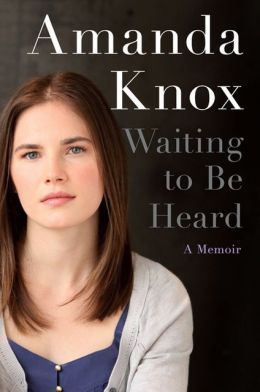
Waiting to Be HeardI can’t pretend to know much about Italian law, however in what I have read regarding the famous Amanda Knox murder trial, their premise in judging those accused of a crime appears to be 180 degrees different from that of American law.  In America, we take the idea of “innocent until proven guilty” to heart, in some cases perhaps too much so.  The idea behind that phrase, however, is that a person should have a fair trial and you really can’t have a fair trial if you are assumed to be guilty.

 Assuming innocence requires the prosecution to come up with hard evidence that a person committed a crime.  Although this can be troubling for a prosecution that is pretty sure someone committed the crime but don’t have evidence to prove it (sometimes there really isn’t much evidence) and requires them to use their “little grey cell” as Hercule Poirot calls them, for the those being charged it is the kindest, most loving way to proceed.  The opposite, which is what Italian law appears to practice, is that of guilty until proven innocent.  This premise puts those being charged at an instant disadvantage, for judge, jury, and prosecution are then unwilling and perhaps unable to see the facts of the case in an objective light.  Any character flaw in the person charged is assumed as an affirmation of guilt, and people can be condemned by hearsay and speculation instead of hard facts.

My belief is that the person bringing a charge should be the one to prove that charge is true.  If the state or police department is charging someone with murder, they have to prove that with evidence, not hearsay, or speculation.  And if they bungle handling the evidence and force confessions out of people that weren’t true, well, shame on them.  Do better police work next time and if the person is guilty they won’t get to walk free.  Covering up poor police/detective work by placing innocent people in jail does nothing for justice, truth, and love for our fellow man.  We have problems with this in America, too.  I think all police departments struggle with wanting to look good over pursuing the truth.  The job isn’t an easy one by any means, especially in a day and age when all too many guilty walk free on technicalities and so on.  However, police work and the law mean nothing, in my opinion, if their primary goals are not the protection of the innocent and the pursuit of the truth.

I’m about halfway through reading Waiting to Be Heard by Amanda Knox.  Her story makes me shudder for every young person blithely going abroad to study or work.  I was one of those young people having taught and lived in the Czech Republic for one year and in China for three.  Like Amanda, I knew exactly zero about the laws of those countries and how their legal processes work.  Nothing really bad happened to me when I was abroad, but it so easily could have.  America in some ways has become a bit of a cesspool.  Our freedom is used for many these days to do drugs and be sexually promiscuous.  Young people grow up thinking, like Amanda Knox, that they are abnormal if they don’t feel comfortable especially with the latter.  We can debate over whether drugs or promiscuity are bad/good, dangerous/healthy and so on, but Americans are for the most part unwilling to hang someone for a crime they didn’t commit no matter how many drugs they do or how promiscuous they are.

In other countries this isn’t so.  In some other countries if you are seen to be of “bad” character, you are guilty even if you didn’t do the actual crime.   And yet we young people skip over to others countries and all too often expect those countries and cultures to bend to our will.  We assume our social and sexual views are superior and should be theirs as well.  In this article I am doing the same, saying that our view of “innocent until proven guilty” is better.  This mere assertion isn’t enough to change the actual way in which other countries’ court systems work.  It is just so heartbreaking that so many of us, no matter how in tune with the world do not take to heart the big differences in how the law is applied around the world.  Having restraint at times, even if we don’t agree with it, can be so very, very important in how others perceive us, and too many use that perception against us if we are accused of something.

Saying this is not to put blame on the victim, but to state that being aware of reality is so very important.  For example, we have the freedom in America to dress any way we like for a job interview, but know that the reality is that dressing too casually or in dirty, wrinkled clothes will cost us the job.  We may profess an “innocent until proven guilty” as far as the law goes, but even in America in practice, people are often immediately judged on their actions or how they dress.  It may not be right, but it is a reality we live in daily.

Continuing on the theme of reality, I am baffled at how bizarre conspiracy theories are allowed in a court of law.  I don’t understand the Italian prosecution in this case, but I certainly admire their imagination.  Conspiracy theories have wormed their way into American courts from time to time, too, and we as a public are easily intrigued and seduced by them.  Many Americans refuse to believe that Amanda is anything but guilty, and many also speculate on the murdered McStay family from California, accusing them of working with drug dealers and so on, all with no hard evidence to prove either as true.

The reality in the Knox case is this: She did not, whether innocent or guilty, have a fair trial.  If you question that reality, I can’t help you,  you’re too far gone already, joining the accusers in Salem, the accusers in the Inquisition, and yes, the accusers of the Jews during World War II.  If you’re simply not sure, I encourage you to read her story and read the information online about her case.  Any thinking person can clearly see she was shafted and railroaded here.

One more thing: I was pretty convinced that Amanda Knox was likely innocent even before hearing the details of her story after reading The Monster of Florence by Douglas Preston and Mario Spezi.  The accusations they encountered from some of the same people involved in Knox’s case are simply too similar.  Devil worshiper cults involved in sex rings and with nary a drop of evidence to prove such a theory? These accusers, like those of Salem, are not in touch with reality, nor concerned with finding the truth.  Whether she did it or not, as a human being, Amanda Knox deserves better.

The Mysterious Affair at Styles, Poirot, and Agatha Christie

Everyone seems to know of Sherlock Holmes, fewer know of Hercule Poirot, though he is just as intelligent and odd as his predecessor.  If both fictional detectives were real and living today, they would be world famous celebrities.  At the beginning, Sir Conan Doyle and Agatha Christie probably didn’t fathom how much society would take to their characters.  The popularity of both are testaments to just how great Doyle and Christie were at telling mystery stories.  It was never about the mystery, really, but about the detectives.

What makes a good mystery, anyway? Some would say if one can guess who did it and/or how then the writer didn’t do their job right.  In some cases, this is true, but one could argue just as strongly that a poor writer is also one who writes a story in which there is no way for the reader to figure out by themselves who did it.  Which view is right?  Neither.  The best mysteries I have read have always been about the detectives.  And if the detectives are insufferable, so’s the story.

Since this musing is about Poirot, I’ll save Holmes for another day.  Hercule Poirot, Agatha Christie’s Belgian detective, a short, dandified and fussy older gentleman with pointy mustaches, is my favorite literary detective.  I like him because he’s a thinking man, because he’s a romantic, because he’s a traveler, and because he’s at turns, funny, kind, and understanding.  He senses the struggles people are going through sometimes even before they do.  In The Mysterious Affair at Styles we are introduced to this Belgian through a younger friend who has admiration for Poirot, but at this point doesn’t really grasp how intelligent the old man is.

Even though I’m an American, reading Agatha Christie mysteries have always felt a little bit like going home.  When I lived in China for a few years, I was elated that the high school where I taught English had a few English copies of her books.  I devoured them and they helped to stave of loneliness and homesickness.  With Christie (and Doyle) the mysteries are comforting.  You know they will be solved even if the murderer doesn’t get his or her due.  The stories are about solving the mystery, but not necessarily about punishing the wrongdoer, as that’s simply not the detective’s job.  With that in mind, the stories have a sense of lightheartedness despite their morbid plots.

Some people may think of Agatha Christie as the stuffy writer of stories that only take place in old mansions full of rich people.  While it is true that many of her stories are in those settings, The Mysterious Affair at Styles included, they are missing the forest of her genius for the trees.  Even with this first Hercule Poirot mystery, she was thinking outside the box.  The murder is straight forward and yet not, so wonderfully not.  In this, her first published novel, she showed right away her affinity for poison as the murder weapon, for intricate plots that at first seem very simple, for paying attention to motivations of the heart, and for small group dynamics.

Christie is also anything but stuffy, in my opinion.  Her stories take place in a variety of locations and with a variety of detectives.  She was a romantic and also had a wild imagination.  And not all of her stories are mysteries, some are simply adventures, some are explorations of the human heart.  One of the most tragic books I ever read is Absent in the Spring which Christie penned under the name Mary Westmacott.  It’s a long exploration in self-delusion, of a woman stranded at a station in Mesopotamia who has a self-realization that could change her entire life, and who ultimately chooses the easier path of keeping things as they are.

The Mysterious Affair and Styles was Christie’s first book, but thankfully not her only one.  She is a reader’s writer, in my opinion.  Her goal is not to stump us, but to get us to think (even while she may be stumping us) and to think like detectives.  Her mysteries are at once simple and complicated, much like life.  The motivations for the murders aren’t always horrible,  sometimes justice is served outright or through oblique channels, and sometimes it’s not.  Good mysteries, and good stories too, are more about the journey than about the ending (though a bad ending is sure to sink any story no matter how well told), and Agatha Christie understood this.  She also for the most part was brief and didn’t waste words, something she has in common with another classic writer, Jane Austen.

Poirot is her best and most endearing character because he has the ability to see straight through to a person’s heart and sympathize with the struggles he sees there, no matter what they are.  He encourages people to take the high road, to live in light, truth, peace and happiness.  Although particular about how he dresses, eats, etc., he isn’t plagued by the personal baggage or drama of more modern detectives.  He is, like Sherlock, his own man, beholden to none and helping others because he feels compelled and called to do so.  His pride and vanity are of those blessed with self-sufficiency and intelligence and almost always explored with a wink and a smile to the reader.

If you have not yet read Agatha Christie, I encourage you to do so.  Her best works are On the Orient Express, The Man in the Brown Suit, and And Then There Were None (formerly Ten Little Indians), though all of her books, especially the Hercule Poirot series and the Miss Marple series are great reads.  Also, I am excited to see on imdb.com that And Then There Were None is getting the miniseries treatment from the BBC in 2015.

Snowpiercer: Revolutionaries Beware

snowpiercerSome things to remember before beginning any revolution, especially one  on a high speed train in the middle of a worldwide ice age:

1. Have a goal other than “I just want to eat steak.”  Revolutions tend to involve casualties and lots of them.  Most revolutions have an ideology behind them, but it’s basically starting a war.  Are you absolutely certain having steak (or whatever the ideology) is worth your life, the lives of your fellow revolutionaries, and the people you are revolting against?

2. You don’t know everything.  The reason for your suffering may not be clear until after your revolution. When stuck on a train caboose for 17 years, you are certain to not have enough information. The information you do have may turn out to be a lie. In addition, you should prepare yourself for the possibility that your suffering may be entirely or mostly your own fault. Others may have had the foresight to prepare for their future and/or the case of a world-wide disaster, and you did not.  You should be prepared for the possibility that what little good you do have is at the benevolence of others smarter than yourself. What these others are doing may be the only way they know to ensure the survival of either themselves or the entire group. Your own lack of foresight will not, in their eyes, justify you taking away everything they have built up.  Be also prepared for the possibility that others are suffering even worse than you are.

3. You may be worse off than you were before. Revolutions are uncertain. You may be only making the way for a new, more violent dictator or absolute anarchy.  Revolutions are chaos, and large numbers of people cannot live with chaos for long.  Anarchy is often corrected by tyranny.  Your goal should be worth risking that possibility.  (The country of America laid out their government in a specific arrangement in order to prevent tyranny and one person or group gaining too much political power.  In recent decades, this system has been messed with and we see our officials abusing their power).

4. Many, many people will die. Today, even after a history of hundreds of thousands of deaths, young (and old) people still believe that “equality” is achievable on earth with evil, selfish human beings.  They think that the Russians and the Chinese just didn’t do it right.  Go ahead, have your revolution, see how happy you feel when you realize you are the orchestrator of the deaths of thousands, if not millions of people.  See how happy you feel when the survivors are now starving and cry out for a leader, any leader, to save them.  See how you feel when the decision is made that because there’s not enough to go around, a certain number of people will have to be eliminated…by you. This isn’t to say there aren’t things worth dying for, but in instigating an uprising, you are taking everyone’s life in your hands, not just your own.

5. You may become everything you hate. This can happen whether your goal is steak or equality. The reality is that society works best with leaders. And leaders by definition have more power than others. Even the smallest bit of power can corrupt. We see this everyday with children who are spoiled: they become tyrants in their own households. We see it at the post office, the DMV, and in Congress or Parliament. These mini-“leaders” scorn the people they are called to serve.  They greedily scoop up benefits and leave little for the rest (perhaps why it’s better to limit government and its benefits).

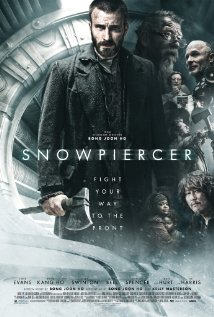
What does all this have to do with Snowpiercer starring Chris Evans and directed by Hoon-Jung Park? Only that while watching the film these are the thoughts that went through my mind. Snowpiercer is at once the story of 1984, Atlas Shrugged, WALL-E and The Hunger Games. To me, all of these stories say one thing: Plan. Have a plan for your life. Have a plan in case something goes wrong. Have a plan in case all goes right. In those plans, strive to attain as much knowledge and as many skills as you can. There may come a day when those plans are the difference between living and dying, the difference between charting your own course or succumbing to tyranny.

There are only a few people at the top of society that control everything. The train creator and engineer, Wilford (played by Ed Harris), has set up a society that absolutely relies on everyone having their place, no matter how awful. We see that most people in the cars in front of the tail accept tyranny for safety and creature comforts including parties and drugs.  Wilford is essentially a “John Galt” type of person, someone who is gifted in intelligence and other abilities. Instead of leaving the rest of humanity to its fate as John Galt does in Atlas Shrugged, he used his talents to make a train that would at least save some. In this, he is admirable. In addition, he also takes on a number of refugees who do not have tickets. In this he is also admirable.

Beyond that, his admirability stops. Is it truly necessary to treat the people in the train so abominably? Wilfred states it’s because of the closed train environment that it is imperative that people die at a far faster pace than they would normally. Resources and space are limited, and a “revolution” is the best way to get people to kill themselves off. Revolutionaries beware.

If you are a proponent of population control, you cannot, if being honest, hate this man and his actions. His ideology is to what you too ascribe. What began as a love of nature has now morphed into a world society in which we are all asked to pay homage to the environment, where the world is portrayed as a closed space with limited resources. Yes, it’s the internet, but I have seen way too many comments stating that it would be best for say, a billion people to die for the sake of “saving the planet.” You may someday get what you wish for, but you will not likely get to choose which billion you are a part of. It is sad that smart people like Wilfred or those who support population control do not have the imaginations to find a better way, a way where all can thrive.

I also find it absolutely hilarious that in the movie the new ice age begins with people deciding they could save the planet from global warming. It does not delve into the more interesting debate on whether global warming actually exists. None of the people on the train were likely responsible for what happened, and, again, only Wilfred did have the ultimate foresight to build a contraption that saved humanity but gave them a perverse society in the process. In each scenario, we see that good intentions don’t always lead to good results.  Again, revolutionaries beware.

Snowpiercer uses violence at the expense of storytelling, and that is my one criticism of it. The fights could have been shortened, allowing for a more in-depth look at life at the head of the train. Aside from the brainwashed teacher and the Hunger Games fashioned Mason (Tilda Swinton), we don’t get a clear picture of what the people living the good life actually think about it. They are ready to kill for it, sure, but more depth could have been explored.

The two drug addicts played by Kang-Ho Song and Ah-Sung Ko thought outside the box, er, train perhaps because of their habit, but they were veritable corpses before the tail section revolutionaries came along. It is interesting that the partying and drug use was the worst at the front of the train near the engine. A direct picture of all too many governments and ruling classes. It is also shows that drug use is most common at societal extremes.  The middle class train cars seemed peaceful and industrious.

The exploration of religion was interesting. Many people today believe they are more intelligent if they reject religion or even the thought of a god. But what happens when people do that, especially en masse, is that they find other gods to follow, for humanity has a spiritual void that must be filled. If any of those people had had any sort of religion, it may not have been quite as easy for Wilfred to condemn certain train citizens to suffering and death. The people in the front cars swallowed the religious and political propaganda so easily because they did not have any spiritual views of their own. Wilfred had to become their god to make it all bearable.

In this review, I have not said much about the directing, acting, camera shots, colors, special effects, etc., used in the film, but have mostly talked about themes I took from the story.  All of those elements were good, as they are in most movies, but Snowpiercer stands out because its themes are food for thought, much food for thought.  It’s steak.  Chewy, juicy steak on which you can add any sauce you like and still enjoy it.