The Great Doctor (Faith) 신의 — review
 If you have not experienced the awesomeness of K-drama, or Korean TV dramas, I highly recommend giving them a view. The set up is a bit different than American TV shows, the episodes are an hour or more long, and there’s usually only one “season” or anywhere from 16-30 episodes in each drama. Given that the stories have a definite end point instead of yearly “will they or won’t they” renewals and extra seasons, the writing, acting and storytelling are stellar and don’t suffer from consecutive seasons that become more mediocre after each year.
The Great Doctor or Faith is a historical drama and romance set in the 1300s during a time when Korea or Goryeo is under the heavy thumb of the neighboring Chinese Yuan dynasty. The young king is returning with a new queen to his homeland after years of living as a hostage in China. The king and queen are being transported by a small group of royal guards called Woodalchi. They are led by weary warrior Choi Young who has been serving for royals for many years. They are attacked during the journey and the new queen is wounded. Only a powerful surgeon can heal her, and one of the king’s advisors suggests going to a place he knows of with a magic gateway to heaven where a famous ancient doctor is said to have gone.
The gateway still exists and Choi Young is sent on a quest to heaven to find the great doctor. “Heaven” is actually modern day Seoul as the “gate” turns out to be a wormhole bending time and space. In a happy coincidence, Choi Young enters the future in direct vicinity of a plastic surgeons convention and kidnaps a surgeon named Yoo Eun-Soo after giving her a practical test to gauge her surgical abilities. The show could have easily just run with the fish-out-of-water theme that it plays up in the first few episodes, but the writers smartly kept that to a minimum and focused more on the drama surrounding the king and queen and how the two protagonists deal with that and begin falling for each other.
From the first episode to the last, the production of The Great Doctor is a stellar, movie-quality experience. The story drags a little at the end, but it’s mostly character driven with plenty of action. If you don’t like the characters at the beginning, they will feel like old friends by the 24th episode. There aren’t many special effects, but what is shown doesn’t look too corny. The magic in the world is left partly unexplained, but the character and action more than make up for that.
Much of the series reminded me of the book series Outlander in which a WW2 nurse gets sent back to ancient Scotland and falls for a younger warrior. Except this version is far more charming and romantic and doesn’t rely on sadism as a way of furthering the plot.
At first I thought Yoo Eun-Soo played by Kim Hee-Seon was annoying and acted a bit childishly for her age, but Kim won me over especially in the second half of the series as her character begins to bloom under the love of Choi Young. Young is played by the popular and easy on the eyes Li Min-Ho who came to fame from the comedy series Boys Over Flowers (if you love high school shows and comedies do not pass Go, do not collect $200, but go directly the Kdrama app where you can watch the series for free). His character is my favorite simply because I enjoy exploring the plight of the “faithful servant.” He’s killed hundreds, possibly thousands of soldiers and others all at the request of the kings that he serves and his soul (Seoul, ha, ha! Okay, I’ll stop being so punny) hurts because of it. He’s damaged in a way that I cannot comprehend, but that I’m sure many of those who are soldiers and good at it can.
Like most shows and films The Great Doctor wasn’t easily made. It suffered from production delays and the lack of a lead actor after the first and second choices for Choi Young fell through. Li Min-Ho stepped up to the plate and did a decent job. He’s a bit younger than the age the role calls for, but Li is believable as the captain of the royal warriors because he commands wonderful screen presence…and he’s tall. 🙂 Okay, all the warriors are tall (at least to me, I’m 5’3″– okay 5’2 and 1/2″), but Li was a good choice as he’s an expert at sporting a sort of bored “I’m cool” expression well-suited to a warrior who has probably seen every atrocity under the sun. Also, the King Gongmin played impressively by Ryu Deok-Hwan is tiny! At least, he appears that way in this production. Ryu does a great job portraying someone who simultaneously has a lot of power and no power and who struggles with it constantly. The king’s personal struggles with power over his own life mirror that of his best warrior, Choi Young, and their relationship is in a way more interesting than that between Young and the “great doctor from heaven.” Also, the king and queen’s relationship is sweet.
I love romances, and the love story in this is wonderful with lots of funny moments and many touching, endearing ones. By the end you just want to shout out the Jerry McGuire line: “You complete me!” Yoo Eun-Soo fills the ache in Choi Young’s heart and vice versa.
One more shout out, and that’s to the soundtrack people. The main theme is especially addicting and reminded me somewhat of the Pirates of the Caribbean music.
You may ask yourself…
I love writing and I LOVE stories. Just saying.

…just how is the first draft of TfD, Season Two coming along?
Answer: Scene by scene, line by line, and day by day.
At Vale TV Studios:
Eva Peters is having an identity crisis and Hezzy Lyon is being brainwashed.
Calvin Bender wakes up with nightmares while Michael Abner puts the moves on Harmony Honeydew.
P.I. Ken Friendle is on the hunt for Tippa Andrews who is soon to meet his mysterious benefactor.
And Sandra Vale’s trying not to be her own personal rain cloud while managing police, press, nosy shareholders and irritable mad scientists.
Don’t even get me started on what The Writers, McGee, Beth, and Daniels have been up to! They are driving head show director Jin Yang nuts! Silly string…it’s a long story.
And “back at the ranch,” I mean Whisper Parish:
Sassy Birch is squatting in Bunny Sweet’s apartment and doing that whole…
View original post 116 more words
The Next Harry Potter–Part 3 of 3
3. The Kingdom series by Cynthia Voigt

This is an older series from the 1990s, but it’s a beautiful, fantasy-type world without magic, and has been one of my favorite series since high school. The themes and story lines in the books are geared towards an older Young Adult audience. The novels are all loosely connected and set in a fictional “Kingdom” and the countries that surround it. The world is medieval, with kings, earls, puppeteers, and so on.
The first of the series, Jackaroo, has a “Robin Hood” plot involving a heroic figure who steals from the rich to give to the poor. Although an engaging story, it’s my least favorite in the series. My two favorites are On Fortune’s Wheel and The Wings of a Falcon. The first is a typical romance/adventure where girl meets boy, girl falls for boy who doesn’t at first care for her, etc., but it’s not a love easily won, and therein lies the story’s strength.
The Wings of a Falcon involves the quest of a young man looking for peace. He starts out as a slave imprisoned on an island and breaks free, taking another boy with him. The book is full of action, some romance, a tragic yet happy ending, and has an epic scope built for the big screen. With names like Oriel, Griff, and Beryl, it fits nicely into a fantasy genre, but again, without the use of magic as a trope.
The standout here is Voigt’s writing, which is notable because one doesn’t note it while reading. One can become completely involved in the story, and that is the point. No ridiculous metaphors (I have to battle this in my own writing), or effusive descriptions, just good, clean storytelling. Modern YA is plagued by “purple prose” possibly because so many of us are going the self-publishing route, but professional writer that Voigt is, she has none of those problems.
Why this could be the next Harry Potter: The stories in the series can appeal to both teens and adults. The “Kingdom” world is adaptable to the screen and invites the possibility of many more stories set in the same world. The settings evoke the romance of nature, from woods, to mountains, to sea. The heroes/heroines in the stories are sometimes childish due to their age, but they are “young adults,” with the emphasis falling on “adults.” The Kingdom world is closer in gravity and themes to The Lord of the Rings and the later Harry Potter books, and is also not a true “series” as the novels take place in some cases generations apart. Still, the tales offer much “scope for the imagination,” as Anne of Green Gables (I’d love to see this series remade!) would say.
Thanks for reading. –Pixie Beldona
The Next Harry Potter–Part 2 of 3
2. Monster Blood Tattoo.

This series is a big reason why I miss Borders. If it hadn’t been at Borders I would have missed out on D.M. Cornish’s incredible world, for the new “American” series title and artwork are not nearly as dynamic as the first cover and title that caught my eye. I fell in love with MBT upon reading the first book, The Foundling, and was sad to see it was months before I saw it on the shelves of my local Barnes and Noble. One of Borders biggest strengths, in my opinion, was that they had a lot of awesomeness waiting to be discovered on their shelves.
Monster Blood Tattoo is the rightful name of this series, but for some reason it was deemed that Americans are too sensitive or something for this title, so it was changed to the bland The Foundling’s Tale. For me it will ever and always be Monster Blood Tattoo, and I will hereafter refer to the series as MBT. Australian author and illustrator D.M. Cornish spent some fifteen plus years creating the world of the Half-Continent. Think Napoleanic-era empire crossed with monsters and monster hunters. The result is as epic and as Tolkien’s Middle Earth with the addition of wonderful hand-drawn portraits of the characters. Add the lengthy, fascinating appendices, and it’s a veritable role-playing game waiting for geekdom.
The Foundling’s Tale as a name isn’t so far off, at least for the first three books (I am hoping there will be more), as it follows an orphan boy with a girl’s name, a kid who wants to be a monster fighter but ends up being a lamplighter on the emperor’s highway. Much like Harry Potter, Rossamünd has to continually reassess his view of world and the people and/or creatures in it. At times he’s just plain dumb, but then he’s a kid. The best character in the series is bonafide monster hunter Europe the “Branden Rose.” She’s one of those hard shell-soft core people for whom Rossamünd presents a dilemma. He insists on seeing the, well, “human” side of monsters, whereas Europe has grown up seeing them as threats only. She’s even had her organs surgically altered so she can fight the monsters with lightening. Interestingly, in the Half-Continent the majority of the monster hunters are women.
Why this could be The Next Harry Potter: Despite its rather simplistic plot at times, the series has great depth and great potential. Cornish has built a vast world meant to be explored in its minutest detail. The world and story can appeal to a wide audience, both kids and adults, and would easily adapt to the screen. The biggest challenge would be the terminology, as Cornish uses quite a few made up words much like HP or LOTR, but a talented screen writer would be able to incorporate these no problem. The series also boasts a wealth of interesting characters, both humans and monsters, political and social commentary, and the important theme that people and creatures be judged not merely for what they are, but for what they do and how they act.
Up next time: The Kingdom
The Next Harry Potter–Part 1 of 3
As anyone who is a fan of books and/or movies knows, the popularity of the Harry Potter series with both kids and adults is something the entertainment industry has long been trying to replicate. Many books have been hailed as “The Next Harry Potter,” in order to get more readers and then viewers if the book becomes a movie. Some of these have failed and some have succeeded, and a few like Twilight have become their own phenomenons.
The next Harry Potter, the next Twilight, the next Hunger Games, we’re always looking for the next big thing. In searching for the “next” and wanting to be first on the bandwagon, we sometimes miss stories that are already there, books that with the right marketing, screenwriter, and stars could make excellent movie franchises. Here are three that I would like to see on the big screen:
1. The Oz series.
Most people are familiar with the iconic 1939 The Wizard of Oz movie starring Judy Garland. It is a film that made excellent use of color vs. b&w, and introduced “Somewhere Over the Rainbow,” a near spiritual hymn that is deeply entrenched in our collective psyche to this day.
What many don’t know is that the author of The Wizard of Oz, Frank L. Baum, wrote thirteen other books about the Land of Oz, some including Dorothy, some not. Over the years, a few of these books have been produced as a cartoon, video, or film, the most recent effort of these was Oz the Great and Powerful directed by Sam Raimi and starring James Franco, Rachel Weisz, Michelle Williams, and Mila Kunis. While it was refreshing to see a new Oz story told, it sadly involved magic, but had none of that film magic that the 1939 movie captured so wonderfully.
A big problem with modern fantasy films whether for children or adults is that they evoke no sense of wonder or excitement of either the actual world or of our imaginations. This is perhaps due to our cynicism today, but also much due to the fact that so many film makers don’t want to tell the stories of these excellent works, but their own stories, only slapping the names and settings of better storytellers on their efforts in order to make a profit. It isn’t necessary to faithfully detail every book page to every line in a screenplay, but capturing the spirit of the original work should, I think, be a goal. I saw nothing of Baum’s Oz world in that recent film and thought it was a shame because of all the talent involved in the project.
Oz suffers a similar fate to that of Peter Pan by J.M. Barrie. In our modern times, we get too caught up in creating our own alternate versions of the story or changing it into a psychological study instead of focusing on telling a good story. This isn’t to say that alternate versions can’t be great, but, again, they should not be wholly cut off from the main source material. The source material is in almost all cases weirder, quirkier, and more interesting than the bland retellings of them crafted to “one size fits all.”
It has been some time since I’ve read the original novel, but the 1939 The Wizard of Oz at least captures Oz even if it didn’t follow the book to the letter. It captured the magic, the danger, and the political intrigue of “the man behind the curtain.” It is a movie much beloved, but not one, I think, for everyone. Let me show another example: Wicked by Gregory Maguire. I have met people who love the story, and some who won’t touch it. It is a story for a specific audience, a story that decidedly won’t appeal to everyone, but to those who desire a deeper understanding of what makes a bad person bad, or a villain a villain. For some, it’s enough to say a character is a villain because, of course evil exists in the world. For others, though, they want to know why, they want a reason either behind the bad actions or behind the label of “evil.” It’s why in the aftermath of mass shootings there is so much focus on the background of the shooter. We think there must be a reason. Sometimes there is and sometimes there isn’t. For those of us who believe there is true evil in the world, no amount of reasons makes any difference, evil is evil. That true evil can’t be corrected by therapy or giving everyone a perfect childhood, well, that’s a hard lesson to learn, and we are a bit loathe to learn that today. We want to blame the gun or the knife, or the possible abuse and/or neglect of the killer, but is the possession of a weapon or any sort of history of suffering really an excuse for the slaughtering of strangers? Aren’t we really, in some form, trying to excuse away the evil in our own hearts? I digress, these all are thoughts best plumbed in an entirely different article. My point is, stories made up to cater to everyone, whether one year to ninety years, whether living in East or West, North or South, often cater to no one.

Back on topic: My favorite book in the Oz series has long been Ozma of Oz. Ozma is a great character, not always nice, and one who shows another side of Dorothy. How wonderful it would be for this tale to have a proper big screen treatment. In fact, all of the books in the series offer plenty of plots, magic, characters, and wonder to compromise an entire franchise of films, if only Hollywood, or someone, would step to it. This is a fantasy world that has stood the test of time, and like more modern fantasy such as Harry Potter, offers much social commentary and philosophizing in the process.
Up next time: Part 2: Monster Blood Tattoo
One Idea
It’s amazing in life how one idea can change everything.
Four years ago I was struggling with wanting to be a writer, yet was finding it difficult to actually get my thoughts and stories down on paper. So I started this blog with the plan of writing a one-page story every day for a year. Now I only got to 270 stories, but it was refreshing to be writing something creative every single day.
Since then, I’ve written online more sporadically than I would like, but that’s due to a project that just took off from that one idea to write every day. One of the short stories I wrote in 2010 was about an actress who had just gotten hired to be on a new TV drama that was a also a reality competition. Trolls for Dust was the name that popped into my head, and I just couldn’t let that story go.
And now I am writing the second book in the series Trolls for Dust and working on advertising the publication of the first book. As of today the Facebook page for Trolls for Dust has reached over 1,000 likes, something I know isn’t that uncommon, yet it took time and dollars to get it to that point. I’ve had so much fun not only self-publishing and creating the story and the series, but also letting my creativity loose a little in coming up with “box” ads. Now there may t-shirts coming in the future and the website itself is presenting more potential, and the second book is looking to surpass the first in both quality, drama, and awesomeness. Also, I have the privilege of giving away books to potential readers on goodreads.com and am looking into selling the print edition at a book fair or two.

I wanted to share this today, just to encourage the pursuit of ideas, especially for the writers out there. One good idea can change your life. It can open doors you never knew existed. I’m writing more now than I ever have before and a blank page no longer scares me, but intrigues me. I’m having fun pursuing a dream that, yes, is leaving a bit of a dent in my bank account, but is so much better than sitting around and thinking, “I wish…” And I’m learning about publishing, advertising, marketing, design, and writing along the way.
Thanks for reading,
Pixie
The Story of Body Image
It’s getting to be that time of year again: swimsuit season. And I think to myself, I should really start getting in shape. Don’t want to scare away all of my nieces and nephews at our family reunion in a month (None of whom are over the age of ten). Don’t want to scare away the rest of my family either…or the fish.
Am I being too dramatic? Welcome to modern times where drama seeps into everything, especially our appearance. The sight of a woman’s natural, hairy legs and/or armpits can send people into conniptions. To not shave is practically a sin in American society. Some people don’t feel like themselves without makeup caked on and their hair dyed and coiffed. And too many of us currently spend our days trying to prevent our bodies from aging by any means necessary: injections, surgeries, exhausting exercise and diet regimens.
I’m saying this not to judge, but to point out, hey, what are we doing with our lives? Being physically young and healthy is pretty awesome. At least, I think it must be, but my experience wasn’t exactly that. My body’s had problems from day one, likely because I was in such a hurry to get into the world already. Premature, on time, or late, not all babies come into the world in perfect health. Some of them struggle throughout their childhood with being physically different or unhealthy. So that begs the question, does our happiness really lie in being perceived–either by ourselves or others–as young and healthy?
For me, trying to work at an ideal of youth or beauty in my physical appearance doesn’t match up with what I actually experienced. If we think about it, this is probably true for a lot of us. Are we trying to reach our lost youth where we worried about the latest zit that sprouted on our chin? Or about being underweight for our age group? Or overweight? When our teeth were so crooked we had to wear braces?
Exactly whose fantasy are we trying to get back to? It’s not a wonder our body image is low when we are trying to attain not our own lost youth and health, but a magazine model’s, or a movie star’s. Talk about impossible goals.
And that doesn’t even include our quest for the “healthy” perfect diet. Diet trends probably do address problems that are true for some people. Some people eat too many carbs and not enough protein. Some people don’t eat their fruits and veggies. Some have a genuine allergic reaction to grains and wheats.
How do we go from that to: Everyone everywhere should reduce their carb intake, everyone should buy a super cool really expensive juicer (instead of eating more fruits and vegetables), everyone should eliminate all wheat from their diet. And the list goes on and on.
Why are we following these diets? Is it really because we have genuine interest in good health or is it because we want to sound and look smart? Do we honestly understand the “science” behind these trends? And what about all the people who smoke, drink, eat what they want, don’t exercise, and live to be 98?
This is one of my favorite quotes from Our Savior Jesus Christ: “It is not what goes into the mouth that defiles a person, but what comes out of the mouth; this defiles a person.” (Matthew 15:11, ESV)
Every time I start fixating on my appearance or bemoaning the new aches, pains, and wrinkles that appear as I age, I tell myself to think about this passage. Eating the correct foods or sticking to the correct exercise regimen might make me physically healthier and my body more pleasing to the eye. But do they really make me a better person? Not really. In fact, sometimes being a health nut has the opposite effect. We become cultists who nag our fellow human beings on their salt intake, fat intake, their flab or lack thereof, etc. I once knew a woman who could tell me the exactly amount of calories in whatever I was eating for lunch. I didn’t think of this as a great gift, but a burden: How could she ever just enjoy eating being so fixated on losing weight?
What comes out of the mouth defiles a person. What comes out. What we say, how we say it, how we treat people, how we honor or dishonor God, these are the important things. If someone comes up with a cure for cancer, are we really going to care how they look in a swimsuit?
And we already know this. I already know this. But it’s so easy to forget in this day and age of airbrushing and people who spend almost all of their time looking good.
So, what’s my body image? It changes by the day, sometimes by the hour, depending on the time of month. If I think I look good, I act far better than if I think I look like a mutant from the planet Flaffluga. So how do I attempt to keep a positive body image 24-7? For me, it’s a matter of faith. I believe that I was created specifically for two purposes: To love God, and to love my fellow man.
My Creator loves me just the way I am, even though in this sinful world, my image and my actions will never be perfect. He doesn’t love my flaws, but loves me despite my flaws. He loves me so much that He doesn’t want me to live in anger, resentment, and pride, but to live free of all that. We put so much emphasis on physical appearance, but none of our ideas about the afterlife from any religion talk about physical beauty. People are judged by what they do, not how they look.
In Christianity, even that is swept aside by the declaration that we can never be good enough to satisfy the law. Thus, Our Savior Jesus took our place and lived a perfect life to save us.
Back to swimsuits. I find the less skin I reveal, the better I feel and the more I can focus on having fun and making sure those around me are having a good time too. And the days I remember God’s love (and it’s so easy to forget), those are the days, those are the times where what comes out of my mouth is sweet, caring, and uplifting. Those are the days I focus on living, not on looking in the mirror.
TfD Goodreads Giveaway!
Goodreads giveaway for Trolls for Dust, Season One!
I have ten free copies of Trolls for Dust, Season One to give away on Goodreads.com! Enter to win today! The giveaway runs through May 30th.
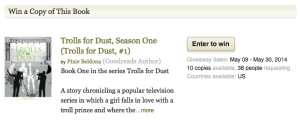
Click on the image above and enter today. You will need to sign up for a Goodreads account.
–Pixie
How Stories Give Us Hope
 If you’re a story addict like me, you may have spent a good chuck of your life either reading, watching, or listening to stories. For me, stories have such a spellbinding quality because they give me hope. Stories of courage, strength, and perseverance give me hope that so much is possible if we just put forth the effort. Bible stories give me hope that I can be forgiven for the evil I have done, and that there’s good beyond the suffering of this world. They also give me the courage to forgive others and to love them, because they too can be redeemed.
Survival stories help me consider my own mortality and what I would be willing to do in the face of death — would I go willingly, or would I fight? If a zombie apocalypse ever descends upon the American Midwest, I am mentally prepared for what I would need to do to survive (however many minutes that might be) thanks to The Walking Dead. The Hunger Games challenges me to consider how I would live in an oppressive, totalitarian society. Would I choose safety or fight for freedom? Would I have the courage to take another’s place if it meant my possible death?
Stories about heroes like The Avengers or Batman or Spiderman give us hope in the extraordinary, that there may be people walking among us who have amazing talents they can use to save and improve lives. In the real world, doctors, nurses, policemen, and paramedics don’t wear masks or capes, but they are heroes just the same and too frequently have to deal with the “Jokers” of this world. We relate to story heroes and sometimes wish we could be like them. Growing up I always imagined I would make a fantastic female Indiana Jones and help save the world from the evils the Nazis would continually unearth. I wanted to be Superman AND Lois Lane, faster than a speeding bullet and a savvy journalist.
With villains, it’s a little different. The best villains are often appealing, not necessarily for the bad that they do, but because they are willing to do whatever they want no matter the costs. Villains challenge us in ways the heroes do not. They have an edge or even a “coolness” we sometimes wish we had. And they often wear black leather. Why is it that we are so attracted to black leather? Villains also represent the evil in the world and in ourselves. The battle against those villains can give us hope that the fight for good is worth it. My favorite thing about Peter Pan and Captain Hook is that they are “worthy” opponents. Great villains are awesome in part because it takes so much effort and courage, both mentally and physically, to overcome them. The heroes who defeat them have been found worthy in some way. That’s hope. Hope for all of us, that our struggles in this life are not in vain. What’s the point in defeating an evil that isn’t really, well, evil?
I have to mention romantic stories. Yes, many are sappy, but almost all have an unflinching belief in true love. Who doesn’t want true love? Bella and Edward may be angsty and annoying at times, but they have epic true love. And sparkly skin. Sparkly skin and black leather, hmm… Okay, back on topic: Love is the ultimate hope in this world, for it can cover over so many sorrows, it can make us forget our hurts, and it can help us see the world in new ways. And it can help us reach our potential. Where would Westley be without Buttercup? If he hadn’t fallen for The Princess Bride, he would have stayed a farm boy instead of becoming a dread pirate, terrifying swordsman, and cunning wit.
If it were physically possible to jump into any of the stories that I so enjoy, I have the hope that I would be at my best self. I have hope that I would be able to see the best in humanity, that I would be the best family member, the best friend, the best worker, the best fighter…and then I think: Why can’t I be like that in real life? Why can’t I make those dreams of being a better person come true? With God’s help, I can, and it all starts with stories, with the “dreams we dare to dream.” Hope.
Hope is the thing with feathers
That perches in the soul,
And sings the tune without the words,
And never stops at all,
And sweetest in the gale is heard;
And sore must be the storm
That could abash the little bird
That kept so many warm.
I’ve heard it in the chillest land
And on the strangest sea;
Yet, never, in extremity,
It asked a crumb of me.
–poem by Emily Dickinson–
 A Life of Story